



When you look at your schedule for the week, I imagine there isn't much empty space. Between your work, your family, and just trying to keep everything running smoothly, the idea of adding one more thing to your plate probably feels exhausting.
When women tell me they want to improve their English, they often describe a heavy feeling. They imagine having to find hours of extra time they simply don't have. They picture themselves sitting at a desk late at night, staring at grammar books, trying to force themselves to study when all they want to do is sleep.
It feels like a mountain you just don't have the energy to climb right now. So, you wait. You tell yourself you'll start when things calm down. When you have more time. When you have more energy.
I want to share something that might take that weight off your shoulders. The effort required to build real English confidence is far smaller than you believe. And once you see the numbers, you might start asking yourself a very different question: "How can I afford NOT to do this?"
Listen to the podcast or watch on YouTube
Why Does It Feel Like You Need So Much Time?
The belief that fluency requires hours of daily study comes from the way we were taught in school. We learned that progress means sitting at a desk, memorising rules, and taking tests. Those methods are incredibly time-consuming. They're also draining. And for someone at your level, they're the wrong approach.
You aren't a beginner anymore. You already know the grammar. You already have the vocabulary. The problem isn't that you need more English. The problem is that you haven't had enough chances to use the English you already have.
This is the gap that so many women get stuck in. They keep studying, hoping that one more course or one more app will finally make them feel ready. But readiness doesn't come from more knowledge. It comes from experience.
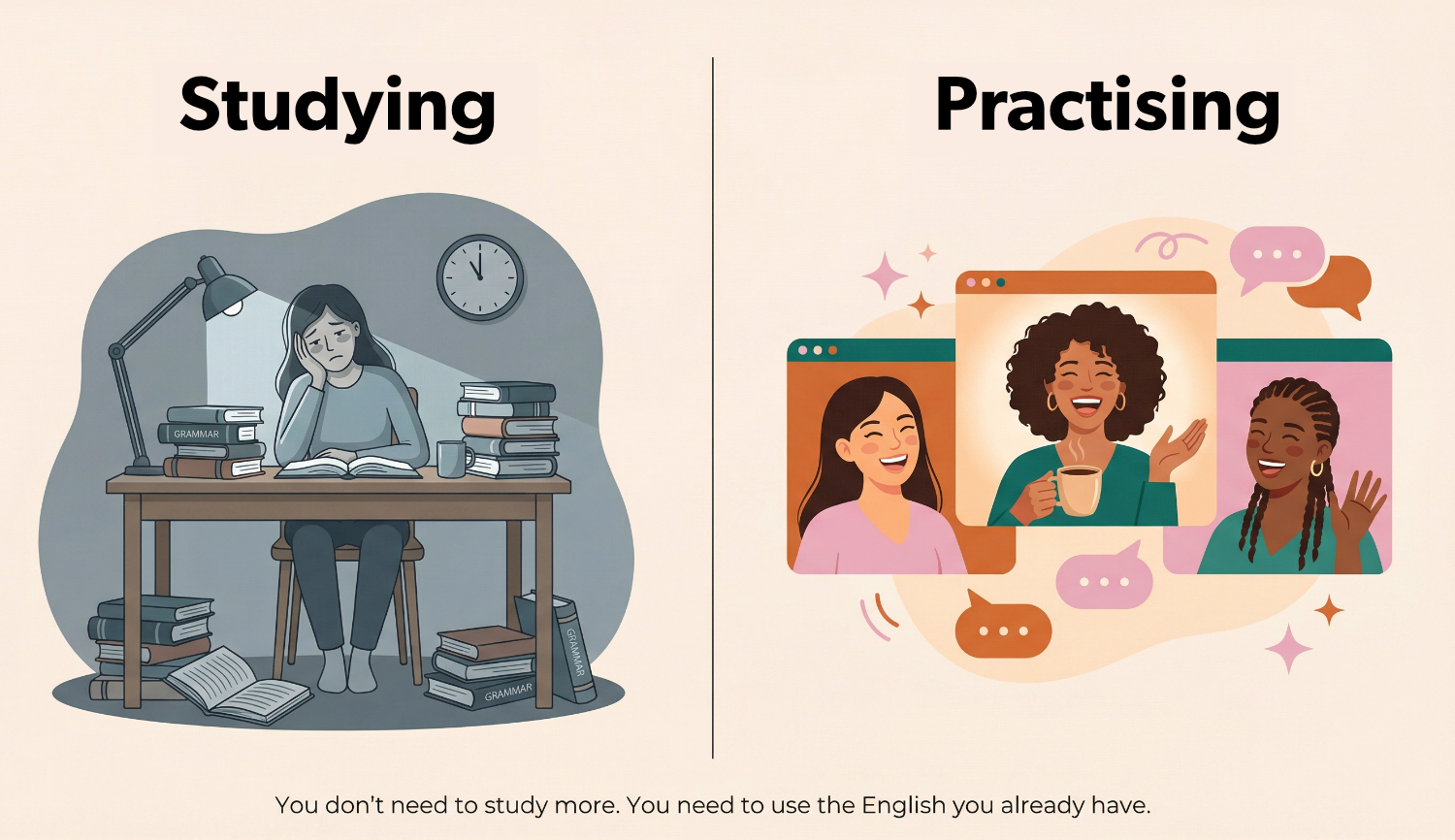
The Difference Between Studying and Practising
Think about learning to cook. You can spend hours reading recipe books. You can memorise every ingredient and every step. But you won't actually know how to cook until you get into the kitchen and start chopping vegetables.
Studying English is like reading the recipe book. It's slow and it takes a lot of mental energy. Practising English, having real conversations with real people, is like cooking. It's active. It's engaging. And it's how you actually learn to do the thing.
The best part? It takes much less time than you think.
What Does the Research Actually Say?
I know you're a smart woman. You don't just want encouragement. You want evidence. So let's look at what the research tells us.
A 2024 study published in Studies in Second Language Acquisition by Cambridge University Press looked at how people develop fluency in a second language. The researchers, Kakitani and Kormos, compared different ways of practising, short, frequent sessions versus longer, more intensive ones.
What they found was clear: short, consistent practice sessions were just as effective as long, intensive ones for building fluency. Spacing out your practice, doing a little bit often, helps your brain build the connections it needs for smooth, confident speech. You don't need to cram everything into one long session. You just need to show up regularly.
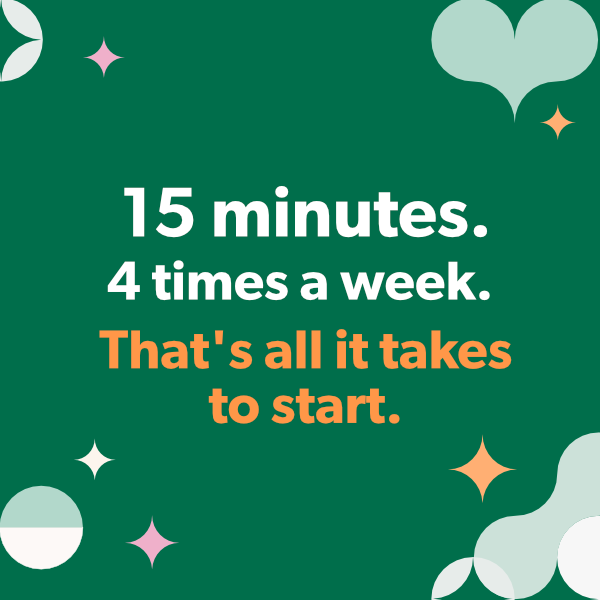
This is great news for busy women. It means you don't need to find a spare hour in your day. You need to find 15 minutes.
How Many Hours Does It Really Take?
Let's look at the numbers. According to language proficiency research, moving from an intermediate level (B1) to an upper-intermediate level (B2) takes roughly 150 to 200 hours of practice.
That sounds like a lot, doesn't it? But let's break it down.
If you try to do that by studying for three hours every Sunday, you'll burn out within a month. But if you practise for just 15 minutes, four times a week, something different happens. You're making steady progress every single week. You're building a routine that fits into your life. And you're gently training your mind to switch into English quickly and easily, without the exhaustion.
At 15 minutes, four times a week, you'll complete about 52 hours of real practice in a year. That's real, meaningful progress. And as your confidence grows, so does your practice time, naturally, without force.
What Does This Look Like in Real Life?
I see this happen every single day inside the Hey Lady! community. Women join us feeling overwhelmed and short on time. They're worried they won't be able to keep up. We tell them to start small.
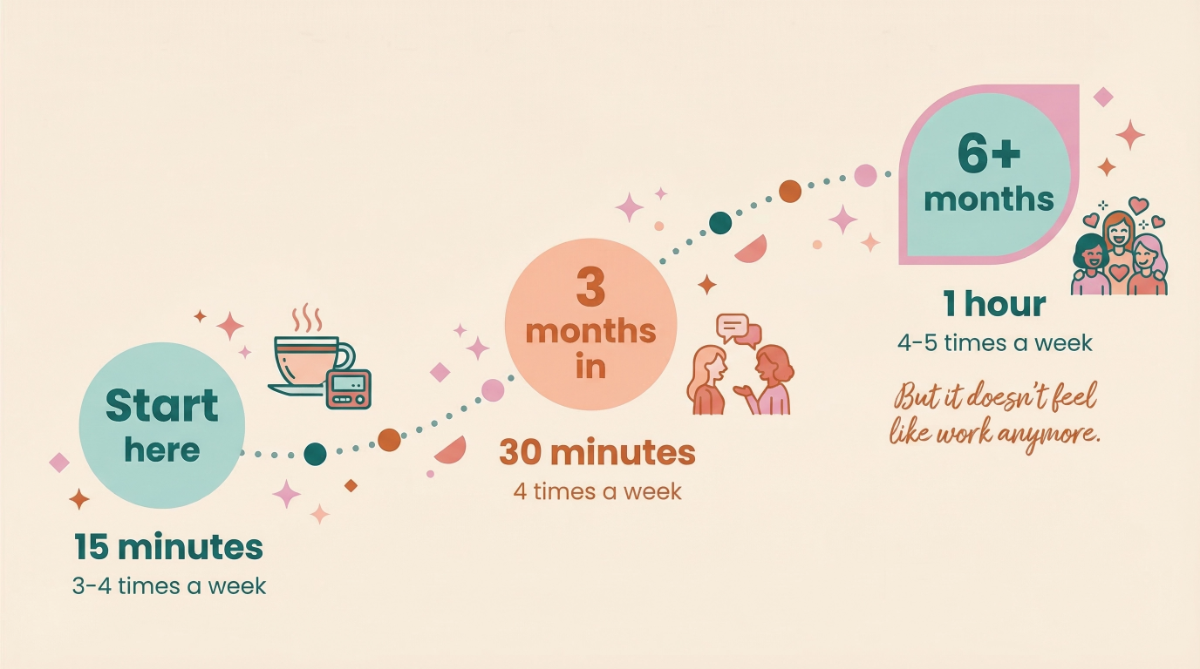
They begin with just 15 minutes of conversation, three or four times a week. That's less time than it takes to drink a cup of coffee or scroll through your phone. And in those 15 minutes, they aren't studying. They're talking. They're laughing. They're connecting with other women from around the world who understand exactly how they feel.
And the results? They're incredible. Because these women are consistent, their confidence grows quickly. They stop freezing when they need to speak. They stop translating every sentence in their head before they say it. They start feeling like themselves again.
The secret isn't working harder. It's showing up regularly. Consistency and frequency are more powerful than pushing hard on quantity. Start with 15 minutes, three to four times a week, and build from there.
What Happens When It Stops Feeling Like Work?
Here's the most beautiful part of this whole process. As our members build their confidence, something shifts. The practice stops feeling like a chore. It starts feeling like something they look forward to.
Our high-performing members often work up to spending an hour in conversations, four or five times a week. But they don't do it because they have to. They do it because they want to. They show up because they're excited to see their friends. They're there for the relationships and the quality of the conversation.
The English practice? It just happens naturally. It's no longer something on their to-do list. It's part of their life.
Can You Really Afford NOT to Do This?
When we feel busy, it's easy to say, "I don't have time for this right now." But I want you to think about something. Think about the cost of waiting.
The real cost isn't the 15 minutes. The real cost is staying exactly where you are. It's the frustration of sitting in a meeting and knowing you have the answer, but staying quiet because you're afraid of making a mistake. It's the feeling of being invisible in a room full of people or not creating the relationships you want with people who are important in your life. It's the pain of knowing you're capable and intelligent but feeling like a smaller version of yourself when you speak English.
Every week you wait is another week of feeling that way. Another week of holding back. Another week of not being fully you.
How Quickly Will You Feel a Change?
When you commit to just 15 minutes of practice a few times a week, everything begins to shift. And the first thing that changes isn't your vocabulary or your grammar. It's how you feel about yourself.
Read the reviews of Hey Lady! members and you will hear them say again and again that this change happens quickly. Almost from the very first conversation.
You start to trust yourself again. You realise that your voice matters, in any language. You discover that you can connect with people from all over the world, just as you are right now. You don't need to be perfect. You just need to start.
You don't need more time. You don't need more energy. You just need a starting point. You need a safe place to use the English you already have.
I know taking that first step can feel daunting, especially when you're already managing so much. But you don't have to figure this out alone, and you don't have to commit to hours of study. I want to invite you to try a different way. It's completely risk-free, and it's designed specifically for women like you.
You can literally get started today.
Here is your simple, three-step plan to get started:
1. Sign up for a free 7-day trial. This gives you full access to the Hey Lady! community so you can look around without any pressure or obligation.
2. Join a friendly, guided conversation. We have short, welcoming calls designed specifically for new members. You'll meet other women who feel exactly the same way you do and women who have overcome their challenges (and it shows).
3. Decide if it's right for you. After your first conversation, you'll still have an entire week to experience as many conversations as you like. You will soon know if this is the safe, supportive space you've been looking for. You are completely in control and cancel easily at no charge if it isn't for you.
You already have the English you need. Now, let's give you the confidence to use it.
Emma xx
Founder at Hey Lady!


