



Why Speaking English Feels Scary (Even When You Know a Lot)
How your brain turns a social risk into a physical threat
You are capable, intelligent, and confident in your own language. You know how to express your ideas, tell a joke, and hold a room. But the moment you switch to English, everything changes.
Your heart races. Your mind goes blank. You start second-guessing every word before it leaves your mouth.
You might tell yourself: "My English isn't good enough yet. I need to be perfect before I speak. What will people think of me when I make mistakes?"
At Hey Lady!, we hear this all the time. And this feeling makes complete sense. But it's not actually about your English.
As an adult, you're used to being competent. You've spent years building your career, your relationships, your identity. Making a mistake in front of others feels like losing all of that.
Your brain is actually wired to protect you from this. From an evolutionary perspective, being rejected by your group was once a matter of survival. So when you're about to speak English and you worry about saying the wrong thing, your brain treats that social risk like a physical threat. It triggers a stress response. That's why you freeze.
The fear of making mistakes isn't a sign that you're bad at languages. It's just your brain trying to keep you safe.
Listen to the podcast episode or watch it on YouTube
Where Does the Pressure to Be Perfect Come From?
Why women feel this pressure more than most
For many of us, it started a long time ago.
If you went to school before the year 2000, mistakes were treated as failures, not feedback. You were graded on what you got wrong, not on what you tried to do. Over time, one belief became internalised: if you aren't perfect immediately, you're simply not smart enough to get there.
Research supports this. A 2016 study by psychologists Kyla Haimovitz and Carol Dweck found that when parents treat failure as something negative, their children grow up believing their intelligence is fixed. That belief doesn't just disappear when you grow up.
And for women, this pressure is often heavier still. Studies on perfectionism consistently show that women are more likely than men to feel a strong need to prove their competence. Combine that with the vulnerability of speaking a second language, and it's no wonder speaking feels terrifying.
Understanding Your Fear Is Not Enough
Why avoidance keeps you exactly where you are
Understanding your fear is useful. But it can only take you so far.
Fear doesn't disappear just because you understand it. It doesn't go away because you learn more vocabulary, or finally nail the past perfect tense. It doesn't vanish because you will it to.
Fear goes away because you stand up to it. You move through it, not around it.
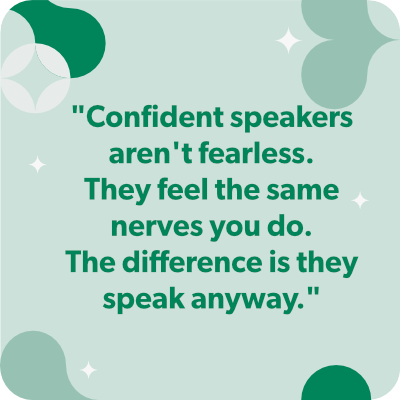
Confident speakers aren't fearless. They feel the same nerves you do. The difference is they don't let fear become a reason to stay silent. They speak anyway. And every time they do, the fear loses a little of its power.
Waiting for your English to be perfect before you speak isn't caution. It's avoidance. And avoidance keeps you exactly where you are.
How to Start Speaking English Without Fear
Why connection matters more than accuracy
You don't need more English lessons. You need to use the English you already have.
And to do that, you need a place where you actually feel safe enough to try.
Not a classroom where every error gets corrected. Not a conversation where you're quietly worrying about what the other person thinks of you. A place where you can search for a word, not find it, keep going, and still be completely understood.
The most important question isn't did I say that perfectly? It's did they understand me? Did we connect?
That's what communication is. And when someone doesn't understand you, that's not a failure. It's useful information. It tells you to try a different word, find another way in, and keep going. You can always get more accurate. You can always find a better way to say something. That work never really stops, for anyone, in any language.
But none of it is possible if you allow your fear to stop you from speaking at all.
At Hey Lady!, we don't judge you for not having the perfect word in the moment. We know you're still learning. We all are. What matters is that you keep showing up and keep trying. That's how your English and your confidence actually grow.
Emma talks about this topic in depth on our podcast. If you want to hear more, watch the full episode here.
Ready to Find Your Voice?
Taking that first step can feel scary. But you don't have to do it alone.
If you're tired of letting the fear of mistakes hold you back, here's a simple way to start:
✨ Start your free 7-day trial. No commitment, no pressure. Sign up and see what's inside.
✨. Come to a conversation. Experience what it feels like to meet people naturally through relaxed, interesting conversations. Our team will be there to guide you.
✨ Decide if it's right for you. You're in control. Stay because it feels like the place you've been looking for. Cancel any time, no charge, if it isn't.
Your voice matters. Mistakes and all. We can't wait to hear it.

.avif)

