


You've been learning English for years. You can hold a conversation, do your job, understand what people say to you. But when someone asks "are you fluent?" you hesitate.
You think about all the words you still don't know. The times you couldn't find the right phrase. The conversations where you felt almost there, but not quite.
So you say: "Not yet. Maybe one day."
The problem might not be your English. It might be the way we've all been taught to think about fluency.
Prefer to listen to the podcast?
What Does "Fluent in English" Actually Mean?
There's no single agreed definition of fluency. Ask ten language teachers and you'll get ten different answers.
Some say fluency means speaking without mistakes. Some say it means thinking in English rather than translating in your head. Some say it means sounding like a native speaker.
The language learning industry makes this worse. Apps promise to "make you fluent." Schools sell courses called "Road to Fluency." Proficiency certificates assign levels, A1, B2, C1, as though fluency is a number you climb toward and one day reach.
No wonder so many adult learners look at all of this and conclude: I'm not there yet.
But there's a more useful definition, one that changes everything.
Fluency is your ability to say what you mean, clearly enough to be understood, using the English you already have.
Not the English you'll have one day. Not the English of a native speaker. The English that's already inside you, right now.
Why the Definition of Fluency Keeps Changing
The academic term for effective language use in context is "communicative competence," a concept developed by sociolinguist Dell Hymes in the 1970s. His point was that language ability is always situational. You don't need to know all of a language to communicate successfully in it. You need to know enough for the situations you're actually in.
A woman who can run a meeting in English is fluent in that meeting. A woman who can talk to her child's teacher, connect with her neighbours, or negotiate with a supplier is fluent in those conversations, even if she can't discuss monetary policy or explain quantum physics in English.
Fluency has never been one thing. It's always been many things. The question was never "am I fluent?" It was always "fluent in what?"
The Fluency Trap: Why Enough Never Feels Like Enough
There's a well-known pattern in how people think about money. No matter how much someone earns, it's very common to feel like it's not quite enough. You imagine a number. If I had that much, I'd feel secure. You reach it. You move the number higher. The feeling of "enough" keeps retreating.
Fluency works exactly the same way.
When you were a beginner, you imagined that intermediate speakers must feel fluent. When you became intermediate, you looked at advanced speakers. When you reached advanced, you compared yourself to native speakers who grew up with the language.
The goalpost keeps moving because fluency, when defined as a level, has no finish line.
There will always be more vocabulary. New expressions. New topics. New situations. Even in your own language, you're still learning every day. You come across a word you don't know. You find a better way to express an idea. That doesn't mean you're not fluent in your own language.
The language industry benefits from this feeling of "not yet." Every new course, every new app, every new certificate promises to close the gap. The gap never closes, because the goal was never defined in a way that could be reached.
You could say it's intentional, that's how the industry was built. The truth is, it would be literally impossible to build a course that covered every possible area of fluency that every person on earth needs.
What Fluency Actually Feels Like (According to Learners Who Found It)
At Hey Lady!, we've worked with women from more than 120 countries, women at every level of English, at every stage of life. And we've noticed something that comes up again and again.
The women who describe finally feeling fluent are almost never the ones who reached a new grammar level or passed a new exam. They're the ones who had a conversation, a real one, where they forgot to worry about their English.
They were too busy connecting.
That's what fluency feels like. Not perfect sentences. Not zero mistakes. Not sounding like someone from London or New York. It feels like being present in the conversation rather than performing it. Like saying what you actually think, not just what you can manage to say.
Members of Hey Lady! describe this moment in their own words:
"I realised I wasn't translating anymore. I was just talking."
"Someone laughed at something I said and I felt like myself, actually myself, for the first time in years."
"I stopped waiting until I had the perfect sentence. And suddenly the conversation started working."
None of these women had perfect English when they described these moments. They had enough English, and they'd stopped waiting for more.
How to Know If You Are Already Fluent Enough
Before asking "am I fluent?" try asking a more useful question: What do I actually want to do in English?
Not in general. Specifically.
- Do you want to feel confident at work, in meetings, in conversations with your team?
- Do you want to connect with people in your community, your neighbours, your children's teachers?
- Do you want to travel without anxiety, to ask for what you need, to follow what's happening around you?
- Do you want to express your real personality, your humour, your opinions, the things that make you, you?
These are specific goals. And you may already be fluent in some of them, even if you don't feel fluent overall.
Take our Fluency Quiz
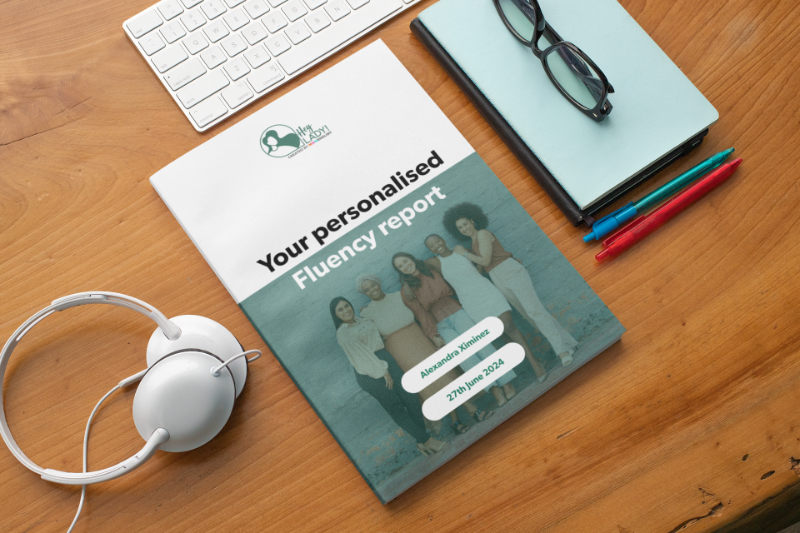
Curious what fluency actually looks like in your life right now? We built a short quiz to help you find out.
It takes about two minutes and gives you a personalised fluency score based on how you actually use English in your daily life — not your grammar level, not your exam results, but the real situations that matter to you.
A lot of women tell us it's the first time they've ever felt like someone was asking the right questions.
Take the Fluency Quiz ->
How to Keep Growing Your Fluency, On Your Own Terms
Fluency doesn't grow through study alone. It grows through use, through real conversations, about real things, in conditions where you feel safe enough to try.
At Hey Lady!, we use a member-led, coach-supported approach. Rather than following a fixed curriculum, members bring the conversations that matter in their own lives. Each month, our coaches introduce a topic, something interesting and worth discussing, along with materials to help you prepare. Members often tell us they end up exploring subjects they've never discussed with anyone before. New topics. New vocabulary. New parts of themselves, finding a voice in English.
And because the community is made up of women from more than 120 countries, you're not just practising English. You're practising with people who understand exactly what this journey feels like. There's nothing quite like it.
Watch the Full Episode on YouTube
We made an episode about exactly this, the fluency trap, what fluency really means, and how to know how much is enough.
It features a listener question from Priya, who lives in Canada and asked something we think a lot of English learners have never dared to say out loud: "I do my job in English. I make my colleagues laugh. Am I fluent? And if not, when will I be?"
Her question, and Emma's answer, might change the way you think about your own progress.
And if you want to experience what real English fluency feels like, in a conversation, with women who are on the same journey.
Start your 7-day free trial at Hey Lady!→


.avif)